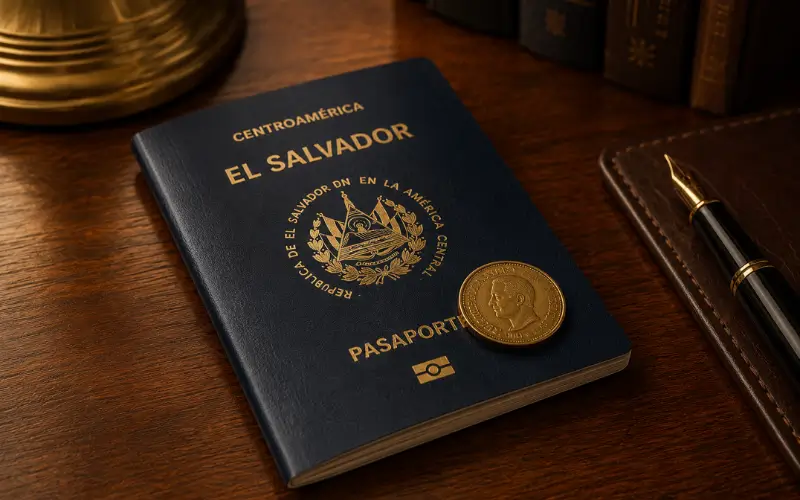
El Salvador built the world’s only Bitcoin-funded citizenship by investment program on the back of a much larger, much shakier bet, making Bitcoin the country’s legal tender. That larger bet has since gone through a major reversal under pressure from the International Monetary Fund, while the citizenship program itself has continued operating on the same terms it launched with.
Table of Contents
What Is El Salvador’s Freedom Passport Program
El Salvador launched the only citizenship by investment program in the world funded directly in cryptocurrency. Applicants contribute one million dollars in Bitcoin or Tether and receive a Salvadoran passport in return. No residency requirements, no interviews, and no language test. The program launched at the end of 2023, built deliberately on the back of the country’s most famous economic experiment, making Bitcoin legal tender in 2021.
The program is formally branded “Adopting El Salvador” and markets itself directly at cryptocurrency holders rather than the broader high net worth audience that most citizenship by investment programs target.
The 2021 Bitcoin Law That Made It Possible
El Salvador’s bet on Bitcoin was about more than the currency itself. It was meant to pull millions of unbanked Salvadorans into the formal financial system and signal to the world that the country was open for investment.
A First In The World
In June 2021, El Salvador’s Legislative Assembly approved a proposal from President Nayib Bukele to make Bitcoin legal tender, the first country in the world to do so. The law required all businesses to accept Bitcoin for goods and services, alongside the US dollar, which had been El Salvador’s official currency since 2001.
To support the rollout, the government launched a state-backed digital wallet called Chivo and paid people to use it, distributing $30 worth of Bitcoin to anyone who signed up. The idea was to seed adoption fast by putting Bitcoin directly into people’s hands through an app the government controlled.
Adoption Fell Short of Expectations
The rollout ran into trouble almost immediately. Public understanding of the new currency was low. A poll published shortly after the law took effect found that nine out of ten Salvadorans did not have a clear understanding of what Bitcoin was, and most disagreed with the decision to adopt it. Usage data tracked a steady decline rather than the growth the government had hoped for. The share of Salvadorans reporting Bitcoin use in everyday transactions fell from roughly 26 percent in 2021 to around 8 percent by 2024, according to polling from the Universidad Centroamericana José Simeón Cañas. A separate 2024 survey found that 92 percent of Salvadorans had not used Bitcoin at all that year, and the small minority who had used it averaged only fourteen transactions annually.
These numbers point to a gap between the law and daily life rather than a failure of the technology itself. A law cannot make people trust a currency, hold it, or reach for it at the till, and a currency only works if people actually use it for transactions. The government spent heavily on incentives like the Chivo signup bonus, but spending money to drive adoption is not the same as building the financial literacy needed to sustain it. A policy this far from how people actually behave day to day was never going to hold up well under pressure.
The IMF Loan That Forced A Reversal
With El Salvador’s debt crisis worsening, the government turned to the IMF for help. It needed a deal that would stabilize its economy, manage a growing debt burden, and rebuild financial and external liquidity buffers that had grown dangerously thin.
The IMF raised concerns almost from the start, warning as early as January 2022 that mandatory Bitcoin adoption posed risks to financial stability and consumer protection, and signaling that continued use of Bitcoin as legal tender would make a loan agreement with El Salvador less likely. The Fund held its position throughout the years of negotiation that followed, and that any support would depend on El Salvador unwinding the mandatory features of its Bitcoin Law.
In December 2024, El Salvador and the IMF reached an agreement on a $1.4 billion Extended Fund Facility. The IMF formally approved the facility on February 26, 2025. In exchange, El Salvador committed to stripping the mandatory parts out of its Bitcoin Law.
A Reserve The IMF Is Still Watching
President Nayib Bukele’s government continues to publicly promote a one-BTC-a-day accumulation strategy, even as the country operates under an IMF program that imposes a zero ceiling on new voluntary Bitcoin purchases by the public sector. As of late June 2026, public trackers showed El Salvador’s government-linked Bitcoin holdings at roughly 7,700 BTC, up from around 5,968 BTC when the IMF program was formalized in December 2024.
The IMF’s position, confirmed by an IMF spokesperson, is that the increase reflects the consolidation of Bitcoin across existing government-controlled wallets rather than fresh purchases, with the total public-sector holding said to remain unchanged. That explanation has had to be repeated every time the public balance has climbed, and its durability through the program’s remaining reviews is still unresolved. If a future review finds the numbers do not reconcile, the disbursements tied to the $1.4 billion facility could be affected.
What This Means for the Citizenship Program
The amendment targeted El Salvador’s broader Bitcoin policy, not the citizenship program directly. What it meant for the Freedom Passport depends on which parts of the program actually relied on the old legal tender status, and which parts never did.
What Changed for Applicants
The amendment did not directly touch the citizenship legislation, but it did remove the legal backdrop the program had used to market itself as part of a broader Bitcoin economy. It has no direct bearing on the program’s contribution requirements, but it undercuts the country’s original pitch.
The contribution still moves in Bitcoin or USDT, the amount is unchanged, and the program runs under its own separate citizenship law rather than the Bitcoin Law. That separation is the legal basis for why it can keep accepting crypto at all. The amendment only stripped Bitcoin of its mandatory status in everyday commerce and tax payments, it never banned the use of Bitcoin as a private payment or as a contribution to a government fund. A donation paid voluntarily in Bitcoin to the Freedom Passport program falls outside everything the amendment actually restricted.
What Has Not Changed
The Freedom Passport does not draw its legal authority from the 2021 Bitcoin Law. It runs under separate citizenship legislation passed in late 2023, and nothing in the 2025 amendment touched that legislation directly. Bitcoin and USDT contributions are still accepted at the same one million dollar threshold, the 1,000 person annual cap is unchanged, and processing timelines have not shifted.
Program Risk Versus Policy Risk
Every citizenship by investment program carries program risk, the chance that processing times slip, fees change, or the cap fills up faster than expected. El Salvador’s Freedom Passport carries an additional layer worth naming separately, policy risk tied to a government actively renegotiating its crypto framework under the supervision of an external lender. The IMF program runs for forty months from its February 2025 approval, with periodic reviews built in. Each review is a fresh opportunity for further conditions to be attached to the country’s crypto policy, even if the citizenship law itself is not the direct target.
Find Global Mobility Options On Sovereign Whale
Citizenship and residency programs vary widely in how they are structured, what they require, and how their underlying legal and economic environment can shift over time. Sovereign Whale’s Global Mobility directory lists citizenship and residency options across multiple jurisdictions, giving readers a way to compare El Salvador’s program against other paths before deciding which one fits their own circumstances.

Frequently Asked Questions
Is El Salvador’s Freedom Passport program still active?
Yes. The program continues to accept applications and contributions in Bitcoin or USDT as of this writing. The 2025 amendment to the Bitcoin Law did not change the citizenship program’s legal basis, contribution amount, or annual cap.
Is Bitcoin still legal tender in El Salvador?
The legal answer depends on which source you read. Some reporting says Bitcoin lost its legal tender status outright in 2025. Other accounts, including IMF documentation, describe the law as keeping the term “legal tender” while removing the features that gave it any practical force, mandatory business acceptance, tax payments, and its classification as a currency. In practice, businesses are no longer required to accept Bitcoin and the government no longer accepts it for taxes.
Why did El Salvador change its Bitcoin law?
El Salvador agreed to a $1.4 billion loan from the International Monetary Fund in late 2024. One of the conditions attached to that loan required the government to narrow the Bitcoin Law and remove the features the IMF considered the highest risk to financial stability. The Legislative Assembly passed the amendment in January 2025, and it took effect in May 2025.
Does the Freedom Passport program depend on Bitcoin being legal tender?
No. The citizenship program runs under separate legislation passed in December 2023. That legislation was not touched by the 2025 amendment to the Bitcoin Law, and the program continues to operate on the same terms it launched with.
What happened to the Chivo wallet?
Chivo was the state-backed digital wallet El Salvador launched in 2021 to drive Bitcoin adoption, distributing $30 worth of Bitcoin to anyone who signed up. As part of the 2025 IMF agreement, the government began winding down its direct involvement in Chivo, one of the conditions attached to the loan.
Is the Freedom Passport a safe long-term investment?
The program itself has operated on stable terms since launch, including through a major reversal of the policy it was originally branded around. That track record is a point in its favor. The broader regulatory environment in El Salvador remains under active negotiation with the IMF, with periodic program reviews that could introduce further conditions on the country’s crypto policy. Applicants should weigh the program’s own stability separately from the surrounding policy environment, and compare it against other citizenship and residency options before committing capital.